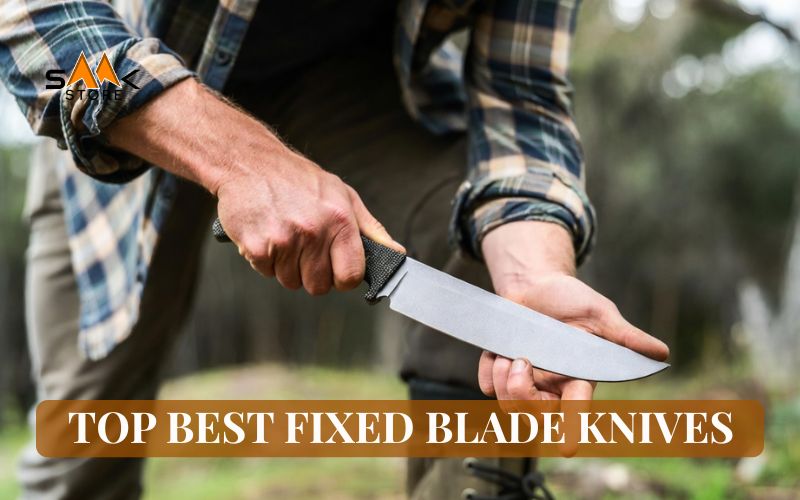
When it comes to outdoor tools that genuinely earn their keep, fixed blade knives stand in a category of their own. Unlike folding knives, they have no hinges to fail, no locking mechanisms to jam, and no moving parts to wear out at the worst possible time. A quality fixed blade is a single piece of steel running from the tip of the blade all the way through the handle and built for strength, built for endurance, and built to work when your life, your hunt, or your camp depends on it.
The challenge, of course, is that the fixed blade knife market is enormous. There are blades designed specifically for military and law enforcement tactical operations, blades engineered for skinning and field dressing big game, compact survival knives built to handle every challenge the backcountry throws at you, and versatile camping knives that serve as the workhorse of any campsite setup. Each category comes with its own design priorities, steel preferences, blade geometry requirements, and sheath systems and the wrong knife in the wrong situation is almost as bad as no knife at all.
This guide covers everything that matters when selecting the best fixed blade knife for your specific purpose. From understanding blade steel and tang construction to breaking down the best options across tactical, hunting, survival, and camping use cases, this resource is built to give you the knowledge to make a confident, well-informed purchase, whether you are an experienced operator looking for a purpose-built tool or a first-time buyer stepping into the fixed blade world for the very first time.
Quick Summary: Fixed blade knives offer unmatched strength and reliability across tactical, hunting, survival, and camping applications. The right choice depends on blade steel, tang construction, blade shape, handle ergonomics and intended use and all covered in full below.
Why Fixed Blade Knives Outperform Folding Knives for Demanding Use?
The fundamental mechanical advantage of a fixed blade knife is simple: there is nothing to fold, nothing to lock, and nothing to open. Every extra mechanical component in a folding knife introduces a potential point of failure, under extreme cold, mud, blood, sand, or simply years of hard use, pivots corrode, lock bars wear, and springs fatigue. A fixed blade eliminates all of this.
The strength advantage is just as significant. Because the steel runs continuously from the tip through the tang and into the handle, a full-tang fixed blade can absorb lateral stress, batoning force, and prying loads that would destroy any folder. Tasks like splitting kindling with a baton, prying open a crate, or applying heavy downward pressure on a cutting surface , these demand a rigid one-piece construction that only a fixed blade provides.
Deployment speed is another critical factor, particularly in tactical and self-defense contexts. A fixed blade is ready the moment it leaves the sheath. There is no opening action required, no blade engagement to confirm, no fumbling in low light or with gloved hands. Military and law enforcement professionals have relied on fixed blades as secondary tools precisely because of this instant readiness.
The takeaway: For any task that involves hard use, heavy loads, exposure to the elements, or situations where reliability is non-negotiable, a fixed blade knife is the right tool. Folding knives have their place, primarily as lightweight everyday carry tools, but for serious outdoor work, tactical applications, and survival scenarios, fixed blades are the standard.
Understanding Fixed Blade Anatomy: What Separates a Great Knife from an Average One
Before evaluating any specific fixed blade knife, it is worth understanding the key design elements that determine performance. These are the factors that experienced buyers evaluate before everything else , and the ones that explain why two knives with similar price tags can perform completely differently in the field.
Tang Construction: The Foundation of Knife Strength
The tang is the portion of the blade steel that extends into the handle. Full-tang construction , where the steel runs the entire length and width of the handle , is the strongest and most reliable option for any knife that will see demanding use. The handle scales (G-10, Micarta, rubber, or wood) are attached to either side of the tang, leaving a visible line of steel at the top and bottom of the handle spine. Full-tang knives can withstand batoning, prying, and heavy chopping without risk of the handle separating from the blade.
Partial-tang knives extend the steel only partway into the handle. These are generally lighter and less expensive but are not suitable for heavy-duty tasks. Skeletonized tangs, common on lightweight neck knives and ultralight survival blades, remove material from the tang itself to reduce weight , acceptable for utility tasks but not for batoning or structural loads.
Rule of Thumb: For any serious tactical, survival, or hunting application, only consider full-tang construction. Partial tang is acceptable for lightweight utility tasks and dedicated kitchen or culinary knives.
Blade Steel: The Core of Long-Term Performance
The steel a blade is made from determines how long it holds an edge, how resistant it is to corrosion, how tough it is under lateral stress, and how easily it can be resharpened in the field. These four properties , edge retention, corrosion resistance, toughness, and sharpenability , exist in tension with one another, and every steel is a tradeoff between them.
• 1095 High-Carbon Steel: One of the most widely used survival and tactical blade steels. Extremely tough, takes an aggressive edge, and is easy to resharpen with basic tools in the field. The trade-off is significant: 1095 will rust quickly without proper care. Used by KA-BAR, ESEE, and TOPS Knives in their primary tactical and survival lines.
• CPM-3V Tool Steel: A premium powder-metallurgy steel offering excellent toughness combined with good edge retention. Highly resistant to chipping and breaking under lateral stress. Preferred for hard-use survival blades that need to baton, pry, and chop without edge failure. Used by Benchmade’s survival line and several high-end custom makers.
• D2 Tool Steel: A semi-stainless tool steel with very high hardness and excellent edge retention. More corrosion-resistant than carbon steels like 1095 but less tough under lateral shock. A popular choice for tactical fixed blades where edge holding is the priority.
• 420HC Stainless Steel: A widely used stainless steel offering solid corrosion resistance and easy sharpening. Buck Knives has refined their heat treatment of 420HC to produce impressive real-world performance. A reliable choice for hunting knives that will be exposed to blood, water, and field conditions.
• CPM-S30V / CPM-S35VN: Premium stainless steels offering high edge retention and good corrosion resistance. More difficult to sharpen in the field compared to 1095 or 420HC but hold their factory edge significantly longer. Best suited for collectors, hunters who want minimal maintenance, and outdoor users with access to proper sharpening tools.
• AUS-8 Stainless: A mid-range Japanese stainless steel offering good corrosion resistance at a reasonable price point. Easier to sharpen than premium steels and more corrosion-resistant than carbon steels. Common in mid-priced tactical and outdoor knives from brands like SOG and Ontario Knife Company.
Blade Shape: Matching Geometry to Task
The shape of the blade determines how it cuts, where the mass is distributed, and what tasks it excels at. These are the most common profiles in fixed blade knives:
• Drop Point: The most versatile and widely used blade shape. The spine curves smoothly downward from the handle to the tip, creating a strong, controlled point and a large belly for slicing. Excellent for hunting, camping, and general outdoor use. The drop point is the default choice when one blade needs to handle multiple tasks.
• Clip Point: The spine is concave near the tip, creating a sharper, more penetrating point with slightly less tip strength than a drop point. Excellent for detail work, piercing, and precision cuts. Commonly found on hunting knives and some tactical designs.
• Tanto: An angular blade shape with a reinforced, flat-ground tip designed specifically for penetration and tactical use. The thick angular tip can pierce hard materials that would damage a drop point. Limited belly means it is less effective for slicing, making it purpose-built for tactical rather than general outdoor use.
• Spear Point: A symmetrical blade shape with the tip at the centerline. Strong, balanced, and effective for both slicing and piercing. Common in military-issue knives and fighting blades.
• Bowie: A large, clip-point style blade with significant length and mass. Historically associated with frontier use, the Bowie shape provides chopping capability alongside cutting versatility. Popular in large survival knives and collectors’ pieces.
Handle Materials: Grip When It Counts
Handle material determines how a knife feels during extended use, how secure the grip is in wet or bloody conditions, and how durable the scales will be over years of hard use.
• G-10 Fiberglass Laminate: The industry standard for serious working knives. Extremely durable, weather-resistant, and grippy even when wet. Does not absorb moisture, will not crack in cold, and provides consistent tactile feedback regardless of conditions. The preferred handle material for tactical and survival fixed blades.
• Micarta (Canvas or Linen): A resin-impregnated fiber material that offers a warm, natural feel with excellent grip. Slightly more comfortable for extended-hold tasks than G-10 but equally durable. Common on premium hunting and outdoor knives.
• Kraton / Rubberized Handles: Soft, shock-absorbing, and extremely grippy even without texture. Kraton absorbs vibration during chopping tasks and provides a comfortable grip for extended periods. Common on budget to mid-range survival and tactical knives.
• Stabilized Wood: Natural wood infused with resin for moisture resistance and dimensional stability. Aesthetically beautiful and comfortable to hold. Primarily found on hunting knives, collector pieces, and traditional camp knives where appearance matters alongside function.
Best Fixed Blade Knives for Tactical Use
Tactical fixed blade knives are purpose-built for military, law enforcement, and self-defense applications. The design priorities are different from hunting or camping knives: these blades emphasize rapid deployment, penetrating tip geometry, secure grip under stress, and reliable sheath retention. A tactical knife needs to clear the sheath silently and quickly, stay secure during movement, and perform under physical duress.
What Makes a Tactical Fixed Blade Effective?
The ideal tactical fixed blade typically falls in the 4 to 6.5 inch blade length range, long enough for effective utility use and self-defense, compact enough for concealed carry on a chest rig, belt, or MOLLE system. Blade steels for tactical knives prioritize toughness and ease of field sharpening over pure edge retention, since a chipped or broken tip in a tactical scenario is unacceptable.
Sheath quality is as important as the knife itself for tactical applications. Kydex sheaths are the standard , they hold the knife securely, allow silent one-handed draw, resist moisture and debris, and integrate cleanly with MOLLE webbing. The retention should be firm enough to prevent movement during physical activity but smooth enough to allow a fast, unobstructed draw.
Top Tactical Fixed Blade Options Available at SMK Store
KA-BAR USMC Fighting Knife: The KA-BAR USMC is one of the most battle-tested tactical fixed blades in history. Its 7-inch 1095 Cro-Van carbon steel blade is tough enough to handle heavy utility tasks while maintaining a sharp, usable edge. The clip-point geometry provides effective penetrating capability alongside solid slicing performance. The leather-washer handle is comfortable for extended carry and provides a secure grip. This is the blade that has served the US Marine Corps since World War II, and it remains a benchmark of tactical reliability.
TOPS Knives B.O.B. (Brothers of Bushcraft) Fieldcraft: TOPS Knives out of Eastern Idaho produces some of the hardest-use tactical and survival blades in the American knife industry. The BOB Fieldcraft features a 6-inch 1095 carbon steel blade, a full-tang construction with comfortable canvas Micarta or Micarta scales, and a design optimized for a complete range of field tasks. The blade geometry delivers excellent performance for batoning, carving, and heavy field use alongside its tactical lineage.
Cold Steel SRK (Survival Rescue Knife): The Cold Steel SRK is a no-nonsense tactical and survival fixed blade that has built a loyal following among military and outdoor professionals. The 6-inch carbon V or SK-5 steel blade is thick-spined and designed for hard-use tasks. Its Kraton handle provides a shock-absorbing, non-slip grip that works reliably in rain, mud, or blood. The included Secure-Ex sheath provides solid retention with multiple carry options.
Tactical Buying Note: For tactical carry, pay close attention to sheath compatibility with your carry system , belt, MOLLE, drop-leg, or chest rig. A high-quality knife in an incompatible sheath creates real-world carry problems that no blade quality can overcome.
Browse the full range of tactical fixed blade knives at SMK Store, including trusted brands from TOPS Knives and Cold Steel.
Best Fixed Blade Knives for Hunting
Hunting knives have entirely different design requirements than tactical blades. Where tactical knives prioritize penetrating tips and rapid deployment, hunting fixed blades are optimized for skinning, field dressing, and meat processing , tasks that demand a controlled, precise cutting edge rather than force or penetration power.
What Makes a Hunting Fixed Blade Effective?
The ideal hunting knife balances blade geometry, steel choice, and handle ergonomics around the specific tasks of breaking down game in the field. Blade length for hunting typically falls in the 3 to 5 inch range , long enough to make clean, efficient cuts through hide and meat, compact enough for controlled, precise work around joints and organs. The drop-point blade shape dominates hunting knives for good reason: its strong, controllable tip resists the accidental piercing of organs during abdominal field dressing, and its generous belly slices cleanly through hide with long, smooth strokes.
Corrosion resistance is a priority for hunting knives in a way it is not always for other fixed blade categories. Blood, stomach contents, and extended exposure to moisture in the field create a corrosive environment. Stainless steel options like 420HC, CPM-S30V, or VG-10 are popular for this reason , they maintain performance without constant oiling between uses.
Top Hunting Fixed Blade Options Available at SMK Store
Buck Knives 119 Special: Few hunting fixed blades have earned the reputation of the Buck 119 Special. Its 6-inch 420HC stainless steel blade , with Buck’s proprietary heat treatment , delivers excellent edge retention and easy field sharpening. The clip-point blade handles both detailed skinning work and heavier processing tasks. The phenolic handle is durable, moisture-resistant, and comfortable for extended hold. The genuine leather sheath is classic in style and functional in the field. The Buck 119 is the kind of hunting knife that gets passed from generation to generation.
Gerber StrongArm: While primarily positioned as a tactical and survival knife, the Gerber StrongArm earns consistent recognition from hunters for its versatility in the field. The 4.8-inch 420HC stainless steel blade handles field dressing efficiently, and the glass-filled nylon handle with its aggressive grip texture maintains control during wet, bloody work. The full-tang construction handles the harder processing tasks , breaking joints, separating bone , that can stress lesser blades.
Benchmade Leuku: Benchmade’s entry into the hunting and survival fixed blade category brings premium CPM-3V blade steel to a classically influenced Scandinavian-style blade. The flat-ground drop-point geometry is optimized for slicing and skinning performance. CPM-3V is tougher than most stainless hunting steels, making the Leuku equally capable of heavy field use when the situation demands it. The canvas Micarta handle provides excellent grip in all conditions.
Hunting Tip: For multi-day backcountry hunts where weight is a constraint, consider a hunting knife in the 3 to 4 inch blade range. A smaller, lighter blade sacrifices some chopping and processing capability but significantly reduces pack weight and improves maneuverability during fine skinning work.
Explore our full collection of hunting knives and fixed blade knives from brands including Buck Knives and Benchmade.
Best Fixed Blade Knives for Survival
A survival fixed blade knife carries more responsibility than any other knife category. In a true survival situation, this blade will be called upon to build shelter, process firewood, prepare food, create fire, fabricate tools, signal for help, and potentially defend. No single blade design optimizes equally for all of these tasks , but the best survival knives achieve a balance that makes them competent and reliable across the full spectrum.
The Ideal Survival Knife Specification
Most survival experts converge on similar specifications for a primary survival blade. A 4 to 6 inch full-tang blade in a durable steel like 1095 carbon, CPM-3V, or similar tool steels provides the right balance between utility and control. The blade needs to be thick enough at the spine (approximately 0.19 to 0.25 inches) to safely handle batoning , driving the spine through wood using a baton to split kindling , without flexing or snapping. A drop-point or clip-point geometry provides the versatility to transition between carving, food prep, and general cutting tasks.
The handle must be full-grip, non-slip even when wet, and free of finger grooves that lock the hand into a single grip orientation. Survival tasks require repositioning the knife frequently , a versatile handle accommodates reverse grip, choked-up grip, and standard grip without fighting the hand. Many premium survival knives include a fire-steel striking surface on the spine , a squared-off section near the handle that works with a ferrocerium rod to generate fire-starting sparks.
Top Survival Fixed Blade Options Available at SMK Store
KA-BAR Becker BK2 Campanion: The Becker BK2 is a repeat performer on survival knife recommendation lists, and for good reason. Its 5.25-inch 1095 Cro-Van steel blade is thick-spined at nearly 0.25 inches, built to baton through hardwood without flinching. The full-tang construction is anchored in an over-molded Ultramid handle that provides a secure, fatigue-resistant grip in any weather. The BK2 is heavy enough to chop effectively for a knife of its size, and its steel is easy to resharpen in the field with a basic whetstone.
ESEE 6P Fixed Blade: ESEE Knives designs its blades specifically for extreme-environment military and survival applications, and the ESEE 6P reflects that heritage. The 6.5-inch 1095 carbon steel blade is covered in a powder-coat finish that helps resist corrosion while maintaining the steel’s natural toughness. The handle is oversized for gloved-hand use and textured aggressively for grip retention under stress. The ESEE 6 includes a versatile Kydex sheath with multiple attachment options. This is a knife built to the same standards as the escape and evasion knives designed for SERE training.
TOPS Knives Tom Brown Tracker: The TOPS Tom Brown Tracker has developed a cult following in the survival community for its unique multi-function blade geometry. The primary edge handles standard cutting tasks, while the hawk bill serration and spine features support specialized survival applications. Made from 1075 high-carbon steel and built with TOPS’ signature full-tang construction, the Tracker is a serious survival tool for users who want maximum functionality from a single blade.
Survival Knife Priority: In a true survival scenario, blade reliability matters more than sharpness or steel pedigree. A 1095 carbon steel survival knife that you can resharpen on a flat river stone outperforms a premium stainless blade that has gone dull with no sharpening equipment available.
Find your ideal survival knife or tactical gear bundle at SMK Store, with free US shipping on orders over $100.
Best Fixed Blade Knives for Camping
Camping knives occupy the most versatile corner of the fixed blade category. Unlike tactical, hunting, or survival blades , which have specific performance priorities , a camping fixed blade needs to handle a broad mix of everyday campsite tasks: food preparation, fire starting, rope cutting, stake driving, shelter setup, and light wood processing. The ideal camping knife is comfortable to use for extended periods, easy to clean, and versatile enough that it rarely gets in the way of any task.
What to Look for in a Camping Knife?
Blade length for camping knives typically falls in the 4 to 5 inch range , long enough to be genuinely useful for food prep and wood processing, short enough for comfortable, controlled work at a camp table or around the fire. Stainless steel blades are generally preferred for camping use given their reduced maintenance requirements , most campers do not want to oil their blade every evening around the campfire.
Handle comfort for extended hold is a priority that does not appear as strongly in tactical or survival knife specs. A camping knife might be used for an hour of continuous food preparation, an activity that reveals handle comfort issues , hot spots, too-aggressive texturing, or a shape that does not transition well between cutting grips , very quickly.
Top Camping Fixed Blade Options Available at SMK Store
Morakniv Companion Fixed Blade: The Morakniv Companion deserves its reputation as one of the best value camping knives ever made. Its 4.1-inch high-carbon or stainless steel blade is ground to a precise Scandinavian (Scandi) grind, which produces a convex secondary bevel that is highly efficient for wood carving and remarkably easy to resharpen even with basic tools. The high-visibility rubberized handle is comfortable for all-day use. Its light weight and included polymer sheath make it a practical addition to any camping kit.
Gerber Strongarm Fixed Blade: Already noted in the survival category, the Gerber StrongArm equally earns its place as a camping workhorse. Its versatile 420HC blade handles food prep, rope cutting, stake driving, and light wood processing with equal competence, and the textured grip stays secure through all of them. Its Molle-compatible sheath keeps it accessible at the campsite or on a trail.
Cold Steel SRK Compact: For campers who prefer a lighter, more compact tool, the Cold Steel SRK Compact offers the same proven design lineage as the full-size SRK in a more manageable 5-inch blade. It handles standard campsite tasks without the additional weight and bulk of a full survival knife, making it an excellent choice for backpackers and hikers who want a capable fixed blade without the extra carry weight.
Camping Consideration: Many campers find that carrying both a compact fixed blade for camp tasks and a folding knife for fine detail work covers all scenarios more effectively than trying to optimize a single blade for everything. Our folding knife collection pairs naturally with any fixed blade camping setup.
Browse our camping knives and outdoor gear collection to find the right fixed blade for your next trip.
How to Choose the Right Fixed Blade Knife?
With a clear picture of what each fixed blade category requires, the buying decision becomes significantly more manageable. The following framework covers the key decision points in sequence , start with purpose, work through specifications, and confirm the purchase with brand and sheath quality.
Step 1: Define Your Primary Purpose
The single most important question is: what will this knife primarily be used for? A blade optimized for tactical carry will underperform for skinning game. A hunting knife is not the right tool for batoning firewood. Define the primary use case first , tactical, hunting, survival, camping, or general outdoor , and let that drive every subsequent decision.
Step 2: Set a Realistic Budget
Fixed blade knives span a broad price range , from under $30 for capable utility options like the Morakniv Companion to $300 and above for premium tactical and custom survival blades. The sweet spot for most buyers falls in the $60 to $150 range, where brands like ESEE, KA-BAR, Gerber, Buck, and TOPS Knives deliver genuinely professional quality without premium pricing. At this level, blade steel, handle materials, and sheath quality are all at the level required for serious use.
Step 3: Choose Blade Steel Based on Use Case
• Tactical use: 1095, D2, CPM-3V , prioritize toughness and field sharpenability
• Hunting: 420HC, CPM-S30V, VG-10 , prioritize corrosion resistance and clean slicing
• Survival: 1095, CPM-3V, SK-5 , prioritize toughness for batoning and edge retention under hard use
• Camping: Stainless options (420HC, AUS-8) , prioritize low maintenance and ease of sharpening
Step 4: Confirm Full-Tang Construction
For any knife that will see demanding use in tactical, survival, or hunting applications, confirm full-tang construction before purchasing. Partial tang is acceptable only for lightweight utility and culinary use.
Step 5: Evaluate the Sheath
The sheath is not an afterthought , it is a functional part of the system. Kydex sheaths are ideal for tactical and survival knives: they are waterproof, provide secure retention, allow a clean one-handed draw, and integrate with MOLLE systems. Leather sheaths suit hunting and traditional camp knives well but require occasional conditioning and do not seal out moisture. Nylon sheaths are adequate but typically represent a budget compromise. If a high-quality knife ships with a poor sheath, an aftermarket Kydex option is worth the additional investment.
Step 6: Consider Blade Length for Your Carry Context
The carry context matters as much as the task. A 7-inch blade that performs well in the field may be impractical for daily belt carry at work. Most buyers find that a 4.5 to 5.5 inch blade length hits the best balance between field utility and practical carry , capable enough for serious tasks, compact enough for all-day wear without fatigue.
Maintaining Your Fixed Blade Knife for Decades of Performance
A quality fixed blade knife, properly maintained, will outlast its owner. The care principles are straightforward but must be consistent to keep the blade performing at its best. If you need a complete maintenance guide, our detailed resource on how to clean, oil, and maintain your blades covers the full routine , from daily cleaning to long-term storage.
The core fixed blade maintenance routine is as follows: clean the blade after every use with mild soap and warm water; dry immediately and completely, paying particular attention to the area where the blade meets the handle scales; apply a thin film of appropriate oil based on blade steel type (food-grade mineral oil for knives that contact food; specialized knife oil for tactical and outdoor blades); inspect the sheath periodically for cracks, retained moisture, or wear at the retention point; and store in a dry environment away from extended contact with leather or materials that trap moisture against the steel.
High-carbon steel blades like 1095 , the choice steel for KA-BAR, ESEE, and TOPS Knives products , require more attentive care than stainless options. Oil after every use, and accept that a protective patina will develop naturally over time. This dark oxide layer is not damage , it is a sign of a well-used tool that is building its own corrosion resistance.
Shop the Best Fixed Blade Knives at SMK Store
SMK Store carries an extensive selection of fixed blade knives from America’s most trusted manufacturers , all through an authorized US dealer with full manufacturer warranty support. Our staff of US veterans and law enforcement professionals selects every knife in our catalog based on real-world performance, not marketing specifications.
Whether you are looking for a tactical fixed blade for duty carry, a purpose-built hunting knife for the field, a rugged survival knife for backcountry use, or a versatile camping blade for your next trip, the right tool is in our catalog. Shop trusted brands including KA-BAR, TOPS Knives, Benchmade, Buck Knives, and Cold Steel , with free US shipping on orders over $100.
FAQs
What is the best fixed blade knife for everyday carry (EDC)?
The best fixed blade EDC knives are typically compact, with a 3 to 4 inch blade and a lightweight sheath that rides cleanly on a belt without bulk. Designs from brands like ESEE (the ESEE 3), Benchmade, and the Morakniv Companion strike this balance well. For EDC, prioritize sheath carry comfort and quick deployment as much as blade specifications.
What blade steel is best for a survival knife?
For survival applications, 1095 high-carbon steel is the most widely recommended choice among experienced survivalists. It is extremely tough, takes a very sharp edge, and , critically , can be resharpened in the field with almost any abrasive material including flat river stones and ceramic surfaces. The trade-off is that 1095 requires consistent oiling to prevent rust. CPM-3V is an excellent premium alternative that adds corrosion resistance and superior toughness to the 1095 formula.
What is full tang construction and why does it matter?
Full-tang construction means the steel of the blade extends the full length and width of the handle, with handle scales attached to either side of the tang. This creates a single, continuous piece of steel from the blade tip to the butt of the knife , the strongest possible construction. For any task involving batoning, prying, or heavy chopping, full-tang construction is essential. Partial-tang knives are lighter but cannot safely absorb the same structural loads.
How long should a fixed blade knife be?
Blade length should match the intended use. Hunting and detail work: 3 to 4.5 inches. General survival and camping: 4.5 to 6 inches. Heavy chopping and large-game field dressing: 6 to 8 inches. Beyond 8 inches, a fixed blade transitions into machete or camp-chopper territory. Most buyers find a 4.5 to 5.5 inch blade to be the most versatile single length across multiple use cases.
Is a fixed blade knife better than a folding knife for camping?
For serious camping and outdoor use, yes , a fixed blade offers superior strength, faster deployment, easier cleaning, and significantly greater durability under hard use. Folding knives are excellent as lightweight supplements for fine detail tasks, but a fixed blade should be the primary cutting tool for any camping setup that involves wood processing, food prep at volume, or tasks that require steady pressure.